You don't have a lead problem. You have a follow-up problem.
Monday morning. The ads have been running all weekend and there's a pile of new enquiries waiting. Someone in the office rings down the list. Half don't pick up. A few say they'll have a think. By Wednesday the pile's been forgotten about, because the phones are full of customers you've already got.
When you've got leads not converting into sales, the easy answer is to buy more. More ads, more bought-in leads, another directory. But if you're already getting 100 or more enquiries a month, more leads won't fix it. Which means you end up paying for the same leak, just a bigger one.
What leads not converting into sales is costing you
Every enquiry has already cost you money. The ad click, the bought-in lead, the directory listing. That money's spent the moment the form comes in.
If nobody gets hold of that person, or they get one call and then nothing, you've paid for a job you never really had a shot at. That's leaving money on the table.
Then there's the time. Your team spends the morning ringing people who don't answer, and the warm ones get the same treatment as the cold ones. And the ones who go quiet don't just disappear. They book with whoever got back to them first.
If you want to see what that looks like with your own figures, the Lead Loss Calculator works it out for you.

Why it happens
Most home improvement businesses have a proper system once the order's in. Ordering, product, fitting, installation. Before the order? Nothing. Follow-up lives in someone's head, a spreadsheet or a pile of sticky notes.
So it comes down to three things.
- People don't answer numbers they don't know. They're at work, or they think it's a sales call, so your first call goes to voicemail.
- Emails don't get read. Even with a welcome email, most people never open it. It lands in an inbox full of junk they check once a week, if that.
- Follow-up depends on whoever's in. Someone's off sick, someone's on holiday, and the follow-ups get forgotten. Everyone's too busy looking after the customers they've already got.
None of that is your team doing a bad job. It's a gap in the system, and it sits right at the front, where the money's been spent.
What to do about it
You can start on all three of these on Monday, with what you've already got.
1. Get back to them in the first minute
The best time to reply is while they're still on their phone with your form fresh in their mind. An hour later they've filled in three more forms. If you can't ring straight away, send something straight away. A short, personal message that says who you are and what happens next keeps them warm until someone can pick it up.
2. Follow up more than once, on the app they actually check
One call and a voicemail isn't follow-up. Plan a few touches over the first fortnight and send them where people actually read them. For most people that's WhatsApp, not email. WhatsApp messages have a 98% open rate, compared with around 20% for email. Chase them enough that you don't annoy them, but don't miss out on them either. Then stop the moment they book.
3. Make it easy to say yes, ask a question or say no
Every message should give them one simple next step. Book a measure. Ask a question. Or tell you they're not going ahead. A clear no is better than a maybe that sits there for weeks, because your team can stop chasing and spend that time on someone who's ready.
Write a short first message, decide when the follow-ups go out, and put one person in charge of making sure they happen. It won't be perfect. Imperfect action beats perfect inaction, it always will.
How we do it
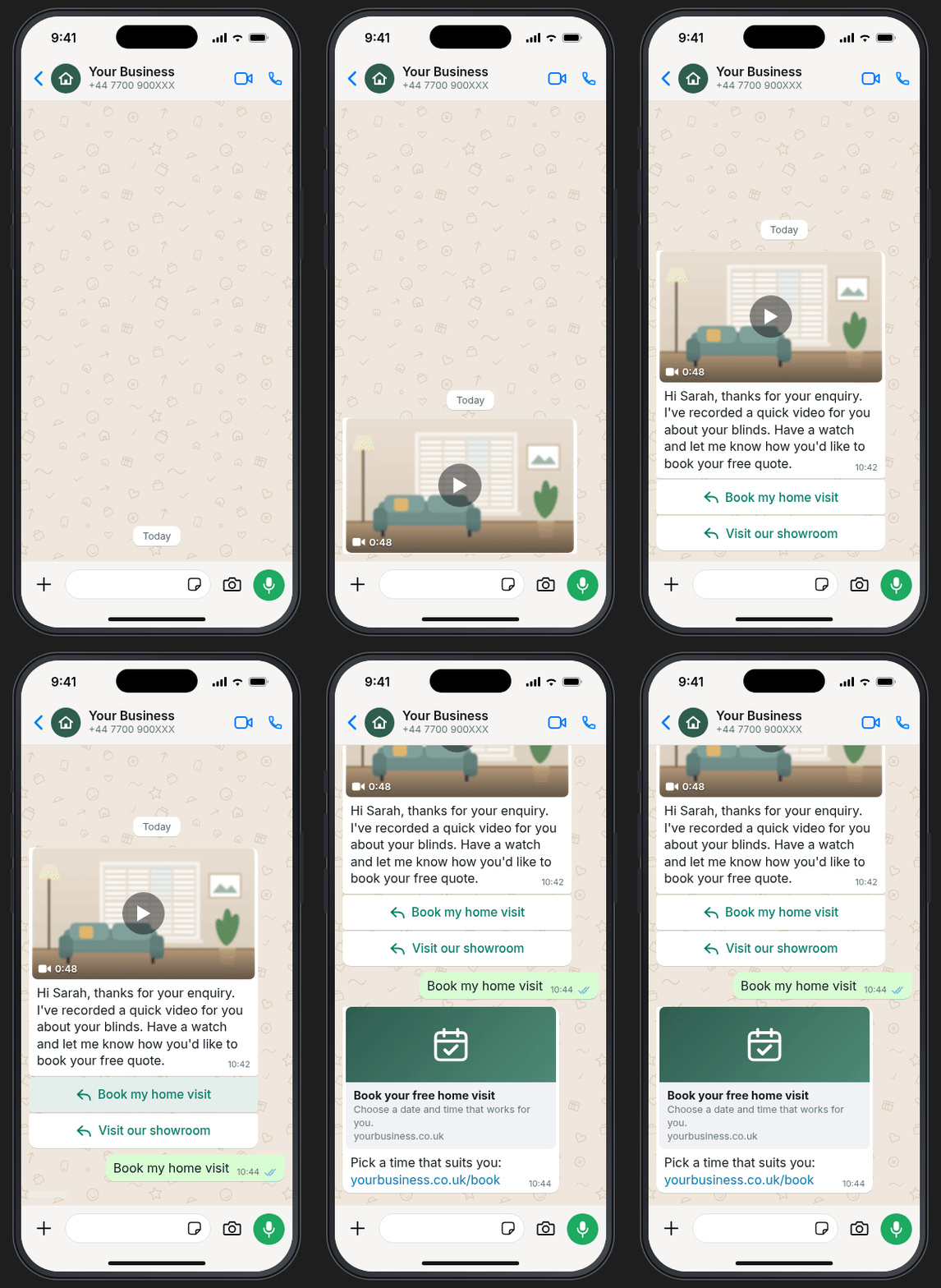
This is what we build and run for you. Every new enquiry gets a WhatsApp from your business within 60 seconds, with a short personal video from you. Then we follow up until they book a measure, a quote or a consultation. Quotes get chased, bookings get confirmations and reminders, and finished jobs get a review request.
It's done for you, so it keeps going when someone's off. No more leads being forgotten about. No more extra ad spend needed. Here's why we use WhatsApp.
You don't need more leads
You need to convert the ones you've already got. More quotes, more installs and more revenue from the leads you're already paying for.
Book a Free Lead Conversion Strategy Call and we'll look at where your enquiries are dropping off.
Free Lead Conversion Strategy Call
Want to see what your missed leads are costing you? Try the Lead Loss Calculator.
Source: WhatsApp messages have a 98% open rate, compared with around 20% for email. WhatsApp Business blog, 15 August 2023.